Research
Built to Be Found
How performance and technical trust turn search into showroom visits, and why having a website doesn't mean you're discoverable.
January 2026
You wouldn’t cut corners in your showroom. You wouldn’t lock your doors in the middle of the day. But a poorly operating website does the digital version of that, quietly, by turning high-intent searchers away before they ever take the next step.
Slow load times cost leads. Poor mobile performance wastes ad dollars. Technical issues reduce how consistently you’re shown in search. These things matter, but they’re often overlooked, or buried in jargon that’s used to upsell solutions instead of explaining what’s actually happening.
About this field guide
This is a field guide to how customers find you, trust you, and decide to take the next step. It covers performance, mobile usability, and technical trust: the three things that decide whether a website earns the visit.
What this supports
A clearer conversation with your dev team
Not “SEO tricks.” A shared understanding of performance, mobile usability, and technical trust so fixes happen in the right order.
Executive Summary
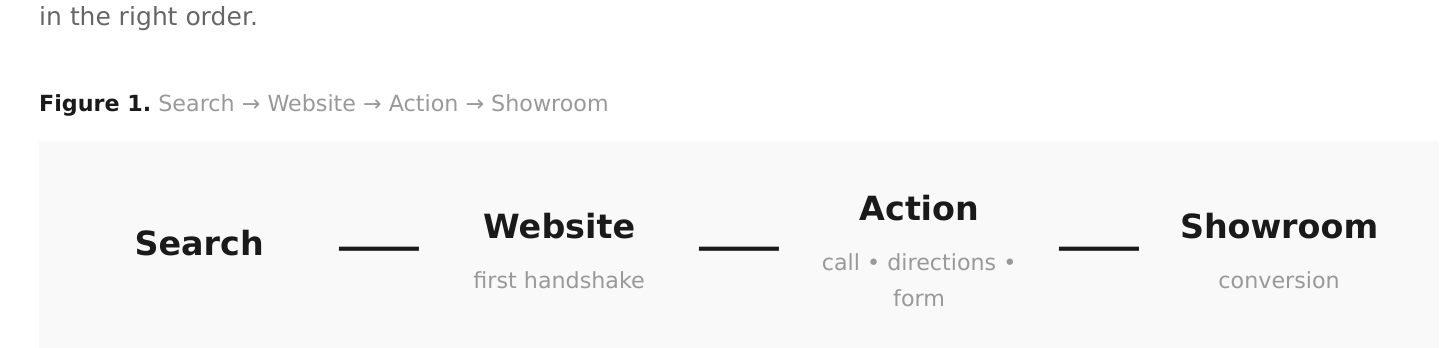
Your website is not your store. For most dealer-based and service-led businesses, it is the first handshake between a potential customer and your brand. Search introduces the business. The website establishes credibility. The showroom or in-person interaction closes the sale.
In 2026, that handshake is increasingly judged on performance, mobile usability, and technical trust. Underperformance rarely announces itself as failure. It appears as inconsistency: fewer high-intent visitors taking the next step, less efficient marketing, and weaker long-term visibility in search.
When multiple results are similarly relevant, experience becomes the differentiator that decides who earns the next step.
This paper is intentionally educational. It avoids gimmicks designed to “game” search and focuses on what consistently builds trust: a site that loads quickly on mobile, responds well to interaction, stays stable while loading, and remains technically clear enough that search systems don’t have to guess what matters.
Core Web Vitals, in plain language
A good experience feels fast, responds quickly, and stays stable while loading. Core Web Vitals describe those behaviors: LCP (main content appears), INP (interaction response), and CLS (visual stability). They’re friction indicators.
What we measure
Experience
Speed, responsiveness, stability
LCP, INP, CLS, plus common root causes: oversized images, render-blocking scripts, server latency, layout shifts, and third-party bloat.
Technical trust
Crawlability, index clarity, hygiene
Broken links, redirect chains, duplicates/canonicals, missing metadata, robots/sitemaps, and structural consistency that prevents ambiguity.
The lead-generation reality
For most specialty retailers, dealers, and service providers, the website is not a checkout lane. It is the handshake. It sits at the top of the funnel where intent is forming and decisions are still fluid.
The customer is not ready to buy yet. They are deciding who feels credible enough to contact or visit.
That is why “good enough” websites quietly underperform. A site can look clean and still leak opportunity. When the mobile experience feels slow or unstable, people don’t diagnose the problem. They move on. The loss isn’t dramatic. It’s simply fewer calls, fewer direction clicks, fewer form submissions, and fewer showroom visits.
A slow, unstable website is the digital version of friction at the entrance. You may never notice it until you quantify what it costs.
Practical framing
You’re not optimizing for online checkout. You’re optimizing for the next step: calls, directions, form submissions, and store visits. That makes speed, clarity, and trust your highest-leverage investments.
Why underperformance is hard to see
In a physical showroom, problems announce themselves. Online, feedback arrives indirectly. Search engines don’t warn you when confidence drops. Ad platforms still deliver clicks. Customers rarely explain why they left. Most of the time, they don’t even know.
The most common failure mode is a plateau. Traffic exists, but growth slows. Visibility feels unpredictable. Marketing costs creep upward without a clear cause. Businesses often respond with visible changes (new designs, new content, more spend) while the constraint remains operational: experience and technical clarity.
When the constraint is performance or technical trust, the site doesn’t collapse. It simply becomes less competitive in the moments that matter most.
Performance as a signal of trust
Performance is often treated as a technical concern. In practice, it functions like a trust filter. When a page loads slowly, shifts unexpectedly, or responds sluggishly to interaction, users feel friction before they process content. That friction erodes confidence even when the underlying business is strong.
Core Web Vitals exist because “fast enough” is not subjective. It’s measurable through real user behavior. LCP captures how quickly main content becomes visible. INP captures how quickly the site responds to interaction. CLS captures whether the page stays visually stable while loading.
Performance doesn’t just improve a score. It reduces the drop-off that happens before intent becomes action.
Common root causes we look for
Oversized images, render-blocking scripts, slow server response, heavy third-party tags, unoptimized fonts, layout shifts from late-loading elements, and pages that request too much before the customer can do anything.
Why mobile is the decision point
Mobile is the default interface for discovery. Local searchers are often comparing options quickly, on the move, and under time pressure. In that context, mobile experience doesn’t influence the decision. It frequently becomes the decision.
When the mobile experience is weak, you don’t just lose a click. You lose the chance to be considered.
What we measure: Mobile
First impression clarity
Load speed on cellular conditions, tap targets, readability, layout stability, and whether calls-to-action are obvious without friction.
The quiet economics of underperformance
The cost of underperformance rarely shows up as a single broken metric. It appears as lost opportunity. Because lead-generation happens before a sale, leakage is easy to dismiss until you quantify it.
The easiest way to understand the problem is to think in “handshakes.” A handshake is a high-intent visitor who takes a next step: calling, requesting directions, submitting a form, or booking an appointment. Underperformance reduces handshakes by introducing friction before intent becomes action.
Missed handshakes are missed conversations. Missed conversations are missed visits. Opportunity cost compounds quietly.
Diagnostic question
If you improved mobile speed and stability by 20%, would your cost per lead fall without changing ad spend? If yes, your site is the limiter. Not your marketing.
Technical trust and clarity
Beyond performance, search systems must be able to interpret your site with confidence. Broken links, redirect chains, duplicate pages, inconsistent canonical signals, and unclear structure introduce ambiguity. Ambiguity leads to inconsistency. Pages may still rank, but not reliably. From the business side, it feels random. From the system side, it looks like uncertainty about what should be surfaced.
Predictability is the asset. Ambiguity is the tax.
Technical hygiene is not glamorous, but it compounds.
What we measure: Technical hygiene
Clarity signals
Canonicals, duplicates, index directives, sitemaps, robots, redirect logic, broken links, missing titles/descriptions, and structural consistency.
Fix order: how improvements compound
One of the most common mistakes businesses make is fixing problems out of sequence. Optimization layered on top of an unstable foundation rarely compounds. The result is work that looks busy but doesn’t move outcomes.
The reliable order is straightforward: ensure the site can be crawled, rendered, and indexed cleanly; remove major mobile experience friction; clarify structure and intent so authority consolidates; and only then invest heavily in content expansion, conversion optimization, and advertising.
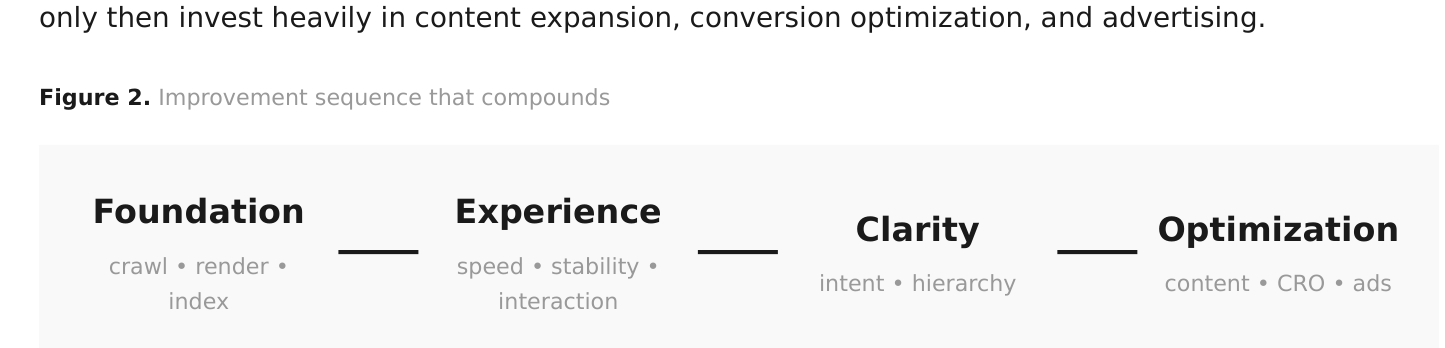
Foundational stability enables experience improvements. Experience enables authority to consolidate. Then optimization compounds.
Fix order is the difference between improvement that compounds and work that cancels itself out.
Why ads cannot fix trust
Advertising creates attention, not confidence. If the landing experience is weak, you pay for the click and lose the opportunity before your message lands. That isn’t a marketing problem. It’s a trust problem.
Marketing can buy the handshake. Only experience and trust can keep it.
When performance and clarity improve, the same spend produces better outcomes because the site stops leaking demand. The goal is not to replace marketing. It’s to make marketing work the way you thought it would.
Closing
A great lead-generation website does not sell online. It earns the visit.
The goal is not perfection. It is removing hidden friction that costs you opportunities before your team ever speaks to the customer. Before redesigns, before campaigns, and before spending more, understand whether your website is earning trust and helping customers take the next step.
As conversational AI and agentic commerce reshape how customers discover businesses, these foundational principles become more important, not less. Sites with strong technical trust and clean structured data will be better positioned to appear across emerging AI-powered discovery surfaces, not just traditional search results.
A note on local visibility
This paper focuses on your website, the digital asset you control. For showrooms, there’s another surface that matters: Google Business Profile and the Map Pack. That’s where proximity, reviews, and local citations determine who appears when someone searches “flooring near me.”
Those signals operate by different rules and deserve separate attention. But here’s the connection: a slow, unstable website undermines the traffic that your local visibility generates. Fix the foundation first.
This research program is published at Showroom Standard.
References
- Google Search Central. Core Web Vitals and Page Experience. Accessed January 2026.
- Chrome UX Report. Core Web Vitals Technology Report. June 2025.
- Google/Deloitte. Milliseconds Make Millions: Mobile Site Speed Study. 2025.
- Portent. Site Speed is (Still) Impacting Your Conversion Rate. September 2024.
Get notified when I publish new research